


You’ve run the numbers on your own household. LED bulbs, less food waste, maybe solar panels or a heat pump, an electric car sitting in the driveway instead of a diesel one. And yet the improvement feels smaller than the effort — smaller than it should, given how much you’ve actually changed. That gap is not a sign you’re doing it wrong. It’s a sign that community involvement is essential for climate action in a way no household budget spreadsheet was ever going to show you, because what moves next depends on people you haven’t met yet.
I’m Al. I trained and taught high school math and science before I became a stay-at-home dad, which mostly means I’ve spent a career and a decade of parenting asking “how do you actually know that?” and expecting a real answer in return. We go to climate rallies, and we’re part of a local group that mostly meets for coffee — which turns out to be the less photogenic half of this whole subject and the more useful one. If you’ve worked through your own list and you’re wondering what’s actually left to do, that’s exactly what this article is for.
🌎🌱🤝 Our Top Pick — Best Book for Talking About Climate Action
Saving Us: A Climate Scientist’s Case for Hope and Healing in a Divided World
I haven’t read this one myself, so here’s why it made the cut anyway: it’s written by a working climate scientist whose entire professional focus is the skill this article argues you actually need, which is having a conversation that changes what the person next to you decides to do.
Hayhoe’s case is that talking about climate change — briefly, honestly, even with someone who disagrees with you — is one of the most useful things a person can do, and this book is the how.
- ✅ Paperback, 320 pages
- ✅ Ships worldwide
- ✅ Written by a practicing climate scientist
| (Goodreads, 2,836 ratings) | ~$14.87 USD | Mid-range
👉 Shop Saving Us (opens in a new tab)Where Individual Action Runs Out of Road
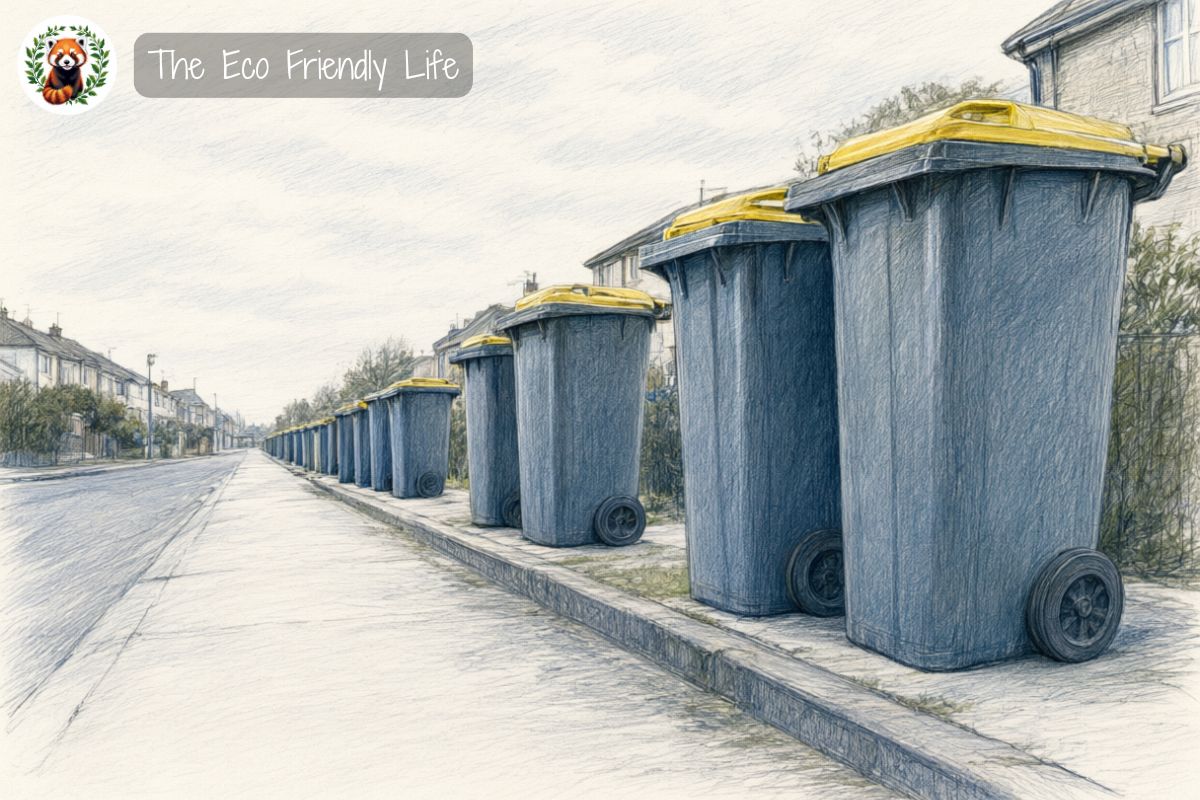
Your footprint has a ceiling you don’t control: Swap every bulb, cut every plastic bag and drive an electric car, and you still don’t control what’s burning at the power station charging it, whether a useful bus route ever reaches your street, or how seriously the causes and effects behind a warming climate get taken by the people who actually hold those levers. None of that is a reason to stop doing the things you can control. It’s a reason to stop measuring your own effort against the wrong yardstick.
The evidence points at scale, not willpower: The IPCC’s Working Group III (opens in a new tab) finds that demand-side changes across just three sectors — buildings, transport and food — could cut those sectors’ emissions by 40 to 70 percent globally by 2050. That is a population-level number. It describes what happens when enough households, workplaces and cities move together, not what happens when one family tries harder than its neighbors.
The target is smaller than it sounds: That same chapter also names how large “enough” actually needs to be — only 10 to 30 percent of committed individuals (opens in a new tab) are needed to shift a group’s norms. That reframes the whole question. You are not responsible for convincing everyone you know. You are one of the people a norm needs, and norms tip well before a majority forms.
Most of the lever sits in cities, not homes: Urban areas accounted for roughly 67 to 72 percent of urban emissions (opens in a new tab) globally in 2020, which means most of what determines a household’s footprint was decided at the scale of a town or a city — zoning, transit, the grid mix — long before that household did anything at all. That is the scale a community group can actually reach. Knowing which changes matter at the household level is still worth doing; it just isn’t the scale where the largest remaining decisions get made.
Checking the claim is faster with company: Our own household went through the usual arc — standard supermarket products, then a DIY phase, then researched alternatives bought only once the claims held up. What actually changed the outcome wasn’t willpower, it was checking things properly, and checking things properly turns out to be a job several people do better than one. A great many confident claims in this space rest on a study funded by whoever is selling the thing, in both directions — plenty of conventional products are worse than advertised, and plenty of eco-branded ones are too.
Individual action was never the wrong idea. It’s the wrong unit of analysis for a problem that gets solved at the scale of streets, suburbs and cities — which is exactly the scale where a normal person, not a policy expert, can actually make a difference. That’s the case for the rest of this article.
What the Evidence Says About Acting Together
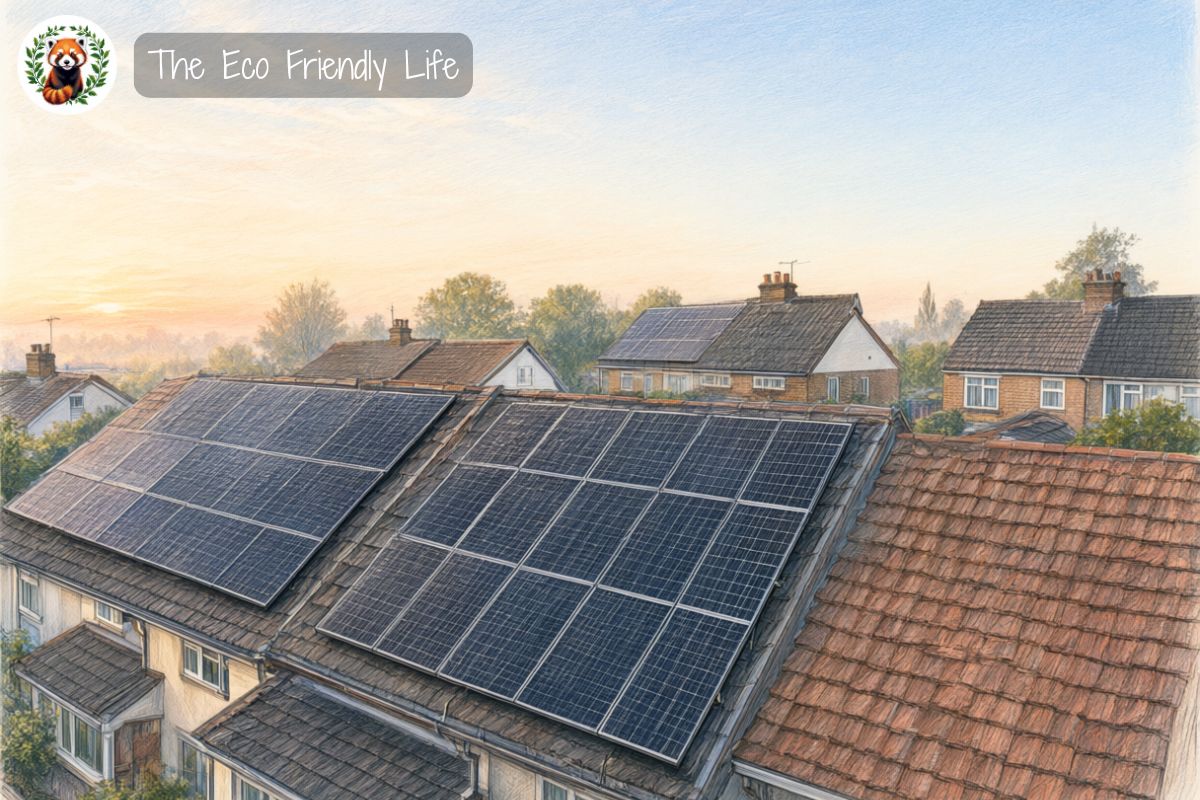
Behavior spreads along a street before it spreads across a country: In a widely cited study of California households, each additional rooftop solar (opens in a new tab) installation raised the probability of another household in the same zip code adopting solar by 0.78 percentage points. Nobody ran an advertising campaign between those two houses. A neighbor simply did something visible, and the next household did the math for themselves.
Talking about it is not a warm-up act, it’s the mechanism: Research on discussing climate change (opens in a new tab) with friends and family found that the conversation itself increased people’s understanding of how strong the scientific agreement actually is — which in turn made them more likely to bring it up again. It’s a reinforcing loop, and the entry cost is a sentence, not a project.
🌿✨ Recommended: Saving Us
If you want the actual words for that first conversation rather than just the argument for having one, this is the book I’d hand you — it’s built specifically around talking to people who don’t already agree with you.
- ✅ Paperback
- ✅ 320 pages
- ✅ Ships worldwide
Most people in the United States never take that step: A Yale climate survey (opens in a new tab) from December 2022 found that 63 percent of Americans rarely (30 percent) or never (33 percent) discuss global warming with family and friends. That figure is specific to the United States, but the shape of it — a subject everyone has an opinion on and almost nobody actually raises — is familiar well beyond it.
How you act on a worry changes what the worry does to you: Research from Yale Public Health (opens in a new tab) on nearly 300 US students found that climate-related worry was linked to depression symptoms only among students who weren’t taking part in any group climate activity. Students doing something collective, even something small, didn’t show the same pattern — while purely individual actions like recycling didn’t carry the same protective effect, because participants read them as too small to matter. That’s a finding about a specific group of students, not a treatment plan, but it’s a useful data point if you’ve ever wondered whether joining something would actually help how you feel about any of this.
Community also determines who survives the emergency, not just who acts on the slow one: After the 1995 Kobe earthquake, social capital research (opens in a new tab) found that most people pulled from the rubble were rescued by neighbors, not by firefighters, and that the communities with the strongest existing social ties recovered fastest afterward. Climate change is producing more of exactly the kind of emergency where that matters.
The pattern across all five of these is the same, however unfamiliar the environmental terms — social capital, peer effects, demand-side mitigation — might sound on first read. The route from one household’s decision to a hundred households’ decisions runs through other people, and unlike most claims in this space, the size of that effect has actually been measured.
None of that is theoretical. It’s already happening in ordinary neighborhoods, in forms that look a lot less dramatic than the research summaries suggest.
What Community Involvement in Climate Action Actually Looks Like
The honest version looks nothing like the imagery: Most of what actually happens is people who care about the same things meeting regularly, comparing notes, and occasionally organizing something together. The rallies are the visible part. The catch-ups are where anything sustained actually comes from, because that’s where the useful information changes hands — who to talk to about a rebate, which installer someone had a bad experience with, what the council is actually doing about it. None of that turns up in a search, and none of it comes out of a meeting with a strict agenda.
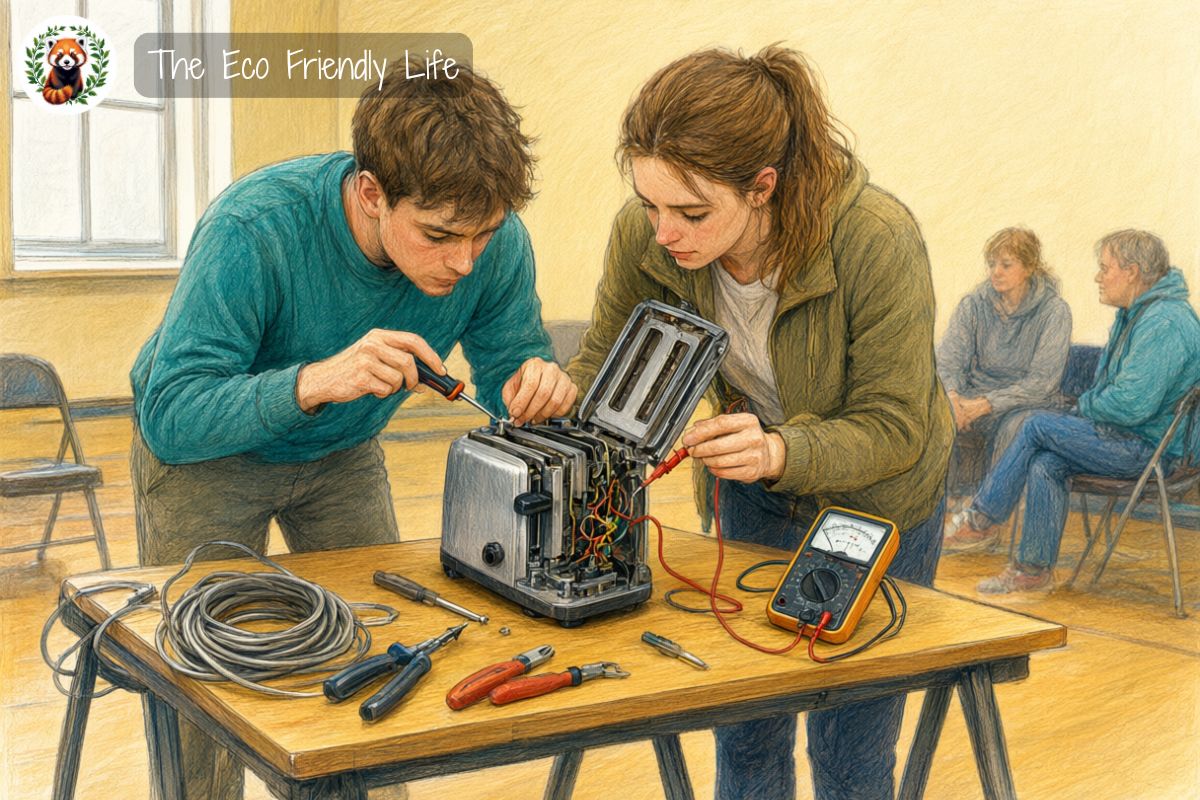
Fixing things together outlasted the idea that we’d all just buy less: There are now over 2,500 Repair Cafés (opens in a new tab) worldwide, and a global survey (opens in a new tab) conducted in 2026 put annual attendance at around 1.5 million visitors bringing in more than 1.6 million items, kept running by roughly 89,000 volunteers. Every one of those events is a handful of people with basic tools and more patience than any single household needs to own on its own.
Borrowing works the same way, for the things you’d only ever use twice: Something like 2,000 Libraries of Things (opens in a new tab) now operate worldwide, a model that only works because a group of neighbors decided a shared drill was more sensible than forty individual ones sitting unused in forty garages.
Energy is the category where the country you’re in matters most: More than 8,000 energy communities (opens in a new tab) now operate across the European Union, and the federation REScoop.eu (opens in a new tab) alone represents around 2,500 of them and 2 million citizens. In the United States, roughly 7.87 gigawatts of community solar (opens in a new tab) capacity was operating across 44 states and the District of Columbia as of June 2024 — useful for the many renters and apartment dwellers who can’t put panels on a roof they don’t own. In Australia, where I live, the Community Power Agency (opens in a new tab) has supported more than 50 community energy groups since 2011, including the Haystacks Solar Garden, the country’s first large-scale solar garden, which opened in April 2024 for people who don’t have suitable roof space of their own. None of these schemes transfer directly between countries — the rebates, the regulations and the ownership structures are all local — but the underlying idea, that a group can own generation capacity a single household can’t justify, holds everywhere.
Whole towns have organized around this for two decades: The Transition movement (opens in a new tab) counts around 1,000 active groups on its global map, spanning more than 67 countries (opens in a new tab) since it began in Britain and Ireland in 2006 — ordinary residents deciding together what their own town’s version of this looks like, rather than waiting for it to be decided elsewhere.
Local government is where a lot of this actually lands: More than 14,000 cities and local governments across 150 countries have joined the Global Covenant of Mayors (opens in a new tab), collectively positioned to deliver 4.5 billion metric tons of CO2-equivalent emissions reductions by 2050 — a scale no household action adds up to, built entirely from local decisions.
Some countries have tried handing the question to ordinary people directly: France’s citizens’ convention (opens in a new tab) on climate seated around 150 randomly selected citizens, who worked through the evidence over several months and produced 149 concrete proposals for the government to act on.
My own version of this is a coffee group, and that’s the point: I go to the rallies, and I’m part of a local group that mostly meets for coffee. People talk about their week, their kids, whatever’s going on — and somewhere in among that, the useful stuff surfaces. It isn’t a committee and there’s nothing to prepare. The practical value is a byproduct of the company rather than the point of it, and that’s the part I’d want a hesitant reader to hear before anything else in this section.
None of this is guaranteed to work, and that’s worth saying plainly: Some groups meet for years and produce very little beyond the coffee. A repair café can save one toaster and nothing else that week. A citizens’ convention can produce 149 proposals and watch a government adopt a fraction of them. This isn’t a guarantee — it’s a set of mechanisms that have been shown to work often enough to be worth your evenings, not a promise that any specific group you join will.
A little of this does take a good book or a small piece of equipment to get started with properly, and that’s worth sorting out before anything else — which is exactly where the next section picks up.
Brands and Tools That Support the Planet — Our Recommendations
Our Retailer Recommendations for Adults
None of this requires new gear, but a couple of books and a little unglamorous equipment genuinely help. The picks below are chosen for direct relevance to this article’s topic and verified availability, not brand recognition.
Blackwell’s
About
A UK-founded bookseller trading since 1879 with millions of titles and worldwide delivery, which makes it one of the few book retailers that can genuinely serve a global readership rather than one country’s market.

Our Recommendation
I chose Saving Us (opens in a new tab) for this list because it’s written by a working climate scientist whose entire focus is the conversation skill this article argues you actually need, though it’s a general book on climate conversation rather than one written specifically about local organizing.
Bookshop.org
About
An online bookseller that gives over 80 percent of its profit margin to independent bookstores rather than to a single retail chain, currently supporting more than 2,500 of them.
Our Recommendation
Not Too Late (opens in a new tab) is the anthology I’d hand someone next — contributions from organizers and scientists worldwide rather than one voice. Ships within the United States; UK readers can use uk.bookshop.org instead.
NHBS
About
A UK-based conservation and wildlife equipment specialist trading since 1985, shipping to more than 195 countries rather than serving one region.
Our Recommendation
The litter picking bag hoop (opens in a new tab) and the 33-inch litter picker (opens in a new tab) are both Waterhaul-made and both in stock here, so one stockist now covers the whole clean-up kit — you’ll still need your own gloves to go with them.
Our Retailer Recommendations for Kids/Families
For families, the same two book retailers carry titles written specifically for kids rather than adults.
Bookshop.org
About
The same independent-bookstore-funding model as above, applied here to its children’s range rather than its general catalog.
Our Recommendation
This picture book (opens in a new tab), Old Enough to Save the Planet, profiles real children already taking action in their own countries, with a how-to-help section at the back for the reader’s own kids. Ships within the United States.
Blackwell’s
About
The same worldwide-shipping bookseller as above, here for its children’s picture books rather than its adult non-fiction.
Our Recommendation
This picture book (opens in a new tab), The Tantrum That Saved the World, is co-written by a climate scientist and dramatizes exactly this article’s argument — a child moving from private frustration to organized collective action. Dispatch runs 2 to 3 weeks.
Between the two tables, that’s what’s actually worth owning for this topic — the rest of what matters is people, not products, which is where the next section picks up.
How to Find Your People, and What Keeps a Group Going
Start with what already exists rather than founding something new: Most places already have more of this than a quick search suggests — a council or municipal climate plan, a local climate action group already meeting nearby, a Repair Café directory, a national community energy register, a school parent group with more overlap than you’d expect, or just a bulletin board at the library.

The barrier to entry is smaller than the word “activism” suggests: For anyone put off by that word — and that’s a lot of people — this is the reassuring truth: the barrier to entry is turning up to a café. There’s no application, no test of commitment, and nothing you need to have read first.
What keeps a group going once the novelty wears off is documented, not mysterious: The Transition movement’s free Essential Guide (opens in a new tab) sets out seven ingredients behind groups that last — healthy group habits, a shared vision, real involvement, outside partnerships, practical projects, a sense of being part of something larger, and actually pausing to notice progress. It’s free, 64 pages, and available in 17 languages.
The single most skipped action is still a sentence to another person: Every grassroots movement, including the coffee-table kind, tends to start with someone simply bringing the subject up — and yet 63 percent of Americans surveyed (opens in a new tab) still rarely or never discuss global warming with the people closest to them. Climate Outreach (opens in a new tab) publishes free, research-backed material specifically on having that conversation well, which is a more useful starting point than either avoiding the topic or leading with statistics.
Taking my kids mattered more than any conversation we’d had at home: Taking the boys to a rally did something no conversation at home had managed. Seeing a crowd of people who cared about the same thing made it real in a way reading about it never had — it stopped being a subject and became something people actually turned up for. Both boys support WWF now, independently of us, and it’s turned into a genuine bridge: a child who has adopted an animal is a child who’ll listen to why habitat matters, and that lands better than any lesson I could construct.
Almost none of this transfers between countries, and that’s fine: How you find a group, what a council actually controls, and which schemes exist locally are all questions with country-specific answers, whether you’re in Australia, the United Kingdom, the United States or anywhere else reading this. climate justice is also part of this picture — the capacity to organize locally isn’t evenly distributed, and that’s worth knowing going in rather than discovering later. Start local, expect the specifics to differ, and don’t assume your search terms will translate directly from somewhere else.
Once you know where to look, the next question is what to actually do with the time — which is what the rest of this article covers.
Practical Daily Tips You Can Action Today
None of these require finding a group first. They’re the smallest useful version of everything covered above.
| Tip | How to implement | How it helps |
|---|---|---|
| Say one true sentence about climate to one person this week. | Mention something you actually did, not something they should do. | Conversation measurably raises (opens in a new tab) understanding of the scientific consensus, which prompts further conversation. |
| Read your council or municipality’s climate plan. | Search the council website for “climate action plan” and skim the section on households. | Shows you which decisions are already on the table locally, before you assume none exist. |
| Search for a Transition group within reach. | Use the movement’s global group map to check for one nearby. | Around 1,000 groups (opens in a new tab) are already mapped — joining one is faster than founding one. |
| Take one broken thing to a Repair Café. | Find the nearest listing and book a slot before you throw the item out. | Over 2,500 Repair Cafés (opens in a new tab) operate worldwide, fixing more than 1.6 million items (opens in a new tab) a year. |
| Check whether community energy exists where you live. | Search your national register or energy cooperative federation. | Community-owned generation reaches households that can’t install their own — over 8,000 schemes (opens in a new tab) operate in the EU alone. |
| Borrow rather than buy for a one-off job. | Check for a tool library or library of things near you. | Roughly 2,000 operate (opens in a new tab) worldwide, and most jobs only need the tool once. |
| Turn up to one public meeting this quarter. | Council session, school board, or a community energy annual general meeting. | Local government is where a large share of emissions-relevant decisions actually get made. |
| Mention what you installed, not what your neighbor should install. | Bring up the solar quote or the insulation job in ordinary conversation. | Each nearby installation (opens in a new tab) measurably raises the odds of the next one. |
| Bring one other person the first time you try a group. | Ask a partner or friend to come with you to the first meeting. | The first visit is the hardest one, and it’s rarely repeated alone. |
| Book a recurring slot rather than waiting to feel motivated. | Put a standing 90 minutes in the calendar rather than an open invitation. | Groups that last run on a schedule, not on enthusiasm. |
That list works whether or not you ever join anything formally — though the next section is for the questions that come up once you’re considering it.
FAQs
Four questions people tend to ask once they’ve read this far.
If governments and big companies cause most emissions, does anything I do matter?
Individually, less than you’d like — which is the point of this article, not a reason to disengage. The IPCC’s own figures (opens in a new tab) put 40 to 70 percent of end-use emissions within reach of demand-side change, and only 10 to 30 percent of committed people (opens in a new tab) are needed to shift a group’s norms. The effective unit is a household acting alongside other households, not a single person acting alone.
I don’t want to be an “activist.” Is there a version of this for me?
Almost all of what’s covered in this article is practical and social rather than confrontational — repair, borrowing tools, energy cooperatives, or simply turning up to a council meeting. My own experience of this has been a coffee catch-up with people who happen to care about the same things, and nothing more dramatic than that.
How do I find a group near me?
Start with your council or municipality’s climate plan, the Transition movement’s global map, your nearest Repair Café listing, and any national community energy register. Expect the specifics to be entirely local to where you live.
Does talking about it actually change anything?
Yes, and it’s measurable rather than just plausible. Discussing climate change (opens in a new tab) with people close to you increases understanding of the scientific consensus, which makes further conversation more likely — and yet 63 percent of Americans surveyed (opens in a new tab) in 2022 said they rarely or never do it.
Whichever of these questions brought you here, the two sections below are where to put a little more time or a little money behind the answer.
Organizations to Support — Our Recommendations
Three organizations doing different parts of this work, all accepting donations directly.
- 350.org (opens in a new tab) is a global grassroots climate movement built from local groups rather than a single head office, which makes it a direct match for everything this article describes — donations are accepted in USD, CAD, EUR, GBP and several other currencies, one-off or monthly.
- The Climate Action Fund (opens in a new tab) at GlobalGiving pools donations and routes them to community-led climate projects in the places most exposed to the damage, from Fiji to Kenya, putting your money into someone else’s local group rather than a distant campaign office. Donations are processed in USD.
- Climate Outreach (opens in a new tab) is a research charity whose entire subject is why climate conversations stall and how to have better ones — the mechanism this whole article rests on. UK donors give through CAF; international donors can give through PayPal.
Any of the three is a reasonable way to put a small amount of money behind the argument this article has been making.
Resources and Further Reading
Three places to go for more than an article can cover.
- IPCC Chapter 5 (opens in a new tab) is the primary source behind the two most important figures in this article — the 40 to 70 percent demand-side potential and the 10 to 30 percent threshold for shifting group norms — along with the underlying evidence on how social influence changes what people adopt.
- The Essential Guide (opens in a new tab) to doing Transition is 64 free pages on starting and sustaining a community group, released under a Creative Commons license in 17 languages.
- Talk Climate (opens in a new tab) from Climate Outreach is the practical companion to the conversation research cited earlier in this article — a handbook built on their own research rather than on messaging instinct.
Between the three, you’ve got the evidence, the how-to-organize, and the how-to-talk-about-it.
Our Related Articles

Understanding Climate Justice And Its Importance
Climate change is no longer a threat on the horizon — it is already reshaping coastlines, displacing communities, and deepening inequality across every continent. But…
Read More (opens in a new tab)
What Is A Grassroots Movement? The Power Of Community Action
When ordinary people come together around a shared concern and decide to act, something powerful happens. A grassroots movement begins not in boardrooms or government…
Read More (opens in a new tab)
How To Get Involved In Local Climate Action
The climate crisis often feels like a distant, insurmountable challenge played out on global stages among world leaders and massive corporations. However, the most tangible…
Read More (opens in a new tab)Conclusion
Individual action was never wrong, but it was always going to fall short of what the numbers actually require, because the mechanism that turns one household’s decision into a hundred households’ decisions runs through other people, not through willpower. Community climate action isn’t the dramatic version of doing something about this. Most of it is repair, borrowing, energy co-ops, council meetings, and a genuinely ordinary amount of coffee — and it’s measurably more effective than trying to carry the whole thing alone.
Have you found a local group, whatever form it takes where you live — and what finally got you through the door the first time?
