


Retirement money tends to sit quietly in the background, ticking away in a pension or a 401(k) while we get on with daily life. But that money is doing something — it’s being invested somewhere, in something, on our behalf. For most of us, what it’s invested in has never crossed our minds. When I finally sat down and looked at my own pension fund last year, I was genuinely surprised by what I found: companies and sectors I would never consciously choose to support. That’s when I started researching the eco-friendly retirement portfolio in earnest.
My name is Al, and I’m not a financial expert — I’m an everyday person who cares about the planet and wants my long-term savings to reflect that. If you’ve been curious about aligning your retirement money with your environmental values but aren’t sure where to start (or whether it’s even possible without risking your financial future), this guide is for you. Please note: this article is general information and education, not personalized financial advice. Your right choices will depend on your own country, age, tax situation, and risk tolerance — please consult a licensed financial advisor before making changes to your retirement savings. Read on to find out what “eco-friendly investing” actually means, what the evidence says about returns, how to spot greenwashing, and how to take practical steps right now.
🌎🌱🤝 Our Top Pick — Best Book on Sustainable Investing
Your Essential Guide to Sustainable Investing — Larry E. Swedroe & Samuel C. Adams
I haven’t read every book on ESG cover to cover, but I chose this one over the alternatives because it matches exactly what this article covers — definitions, performance evidence, greenwashing, and how to build a values-aligned portfolio — written by a respected plain-English investment author alongside an ESG fund manager, and reviewed by the CFA Institute.
It’s the honest, evidence-based starting point I wish I’d had. If you want one resource to deepen everything this guide introduces, this is the one to reach for.
- ✅ Evidence-based, jargon-light
- ✅ Covers ESG, SRI, and impact investing
- ✅ Ships globally (UK via uk.bookshop.org; elsewhere via Amazon)
| Ebook ~$14.99 (available now) / Paperback ~$18.99 | Budget
👉 Shop the book (opens in a new tab)What “Eco-Friendly” Actually Means for Your Retirement Money
It’s a spectrum, not a switch: “Eco-friendly investing” isn’t a single thing you opt into — it’s a range of approaches with meaningfully different mechanics. At one end, ESG integration means a fund manager considers environmental, social, and governance factors alongside financial ones when picking stocks. Negative screening (sometimes called exclusionary screening) goes further: it simply cuts out whole sectors — fossil fuels, tobacco, weapons — from the portfolio. Positive or best-in-class screening keeps the sector but picks the companies with the best ESG performance within it. Thematic investing focuses the whole portfolio on a single environmental theme, such as clean energy or water. And impact investing aims to generate measurable, intentional environmental or social outcomes alongside a financial return — think green bonds or community development loans.
The terms people confuse most: ESG, SRI, and “ethical” overlap but aren’t identical. SRI (socially responsible investing) is an older term that typically emphasizes exclusions and shareholder engagement; ESG is a data-and-analysis framework used by fund managers to assess non-financial risks; “impact” requires measurable outcomes. The CFA Institute (opens in a new tab) offers a clear, neutral breakdown of these distinctions — a useful first stop for anyone who wants a professional primer before choosing a fund. Understanding the differences matters because a “sustainable” label on a fund could mean any of the above, or a combination.
This is mainstream now: If you’ve been thinking of values-aligned investing as a niche preference, the scale says otherwise. According to the US SIF (opens in a new tab) 2025/2026 Trends Report, US sustainable assets reached $6.6 trillion — about 11 percent of the $61.7 trillion US market. Around 70 percent of respondents in that report said they were committed to sustainability over the long term. This is no longer a fringe preference; it’s a significant and growing part of how money is managed globally. For a broader look at the system your retirement savings operate within, the green finance (opens in a new tab) framework is worth understanding as context.
Interest is high — action is lagging: A 2026 Morgan Stanley survey of individual investors found that 92 percent were interested in sustainable investing, up from 88 percent the previous year — yet the average allocation to sustainable assets dipped from 33 percent to 31 percent. The gap is usually not ideology; it’s confusion about how to start, and that’s precisely what this guide addresses.
Your pension is your biggest lever: Most people think about eco-friendly living in terms of what they buy or how they travel. But your retirement account — whether it’s a pension, a 401(k), or a superannuation fund — is almost certainly the largest pool of money you’ll ever manage. Checking what it’s invested in, and whether a more values-aligned option exists, is one of the highest-impact decisions you can make. If you’re new to the idea, a solid grounding in responsible investing (opens in a new tab) is worth the time before going further.

🌿✨ Recommended: Your Essential Guide to Sustainable Investing
This is the book I’d hand to anyone who wants to go deeper on everything in this section — ESG versus SRI versus impact, how fund managers apply these frameworks, and what the academic research says. Evidence-based and written in plain English.
- ✅ Evidence-based and jargon-light
- ✅ Covers all three major approaches
- ✅ Available as ebook for immediate access
Understanding the landscape is the foundation — once you know the difference between ESG integration, negative screening, and impact investing, you’re ready to ask the harder question that trips up most people: does going greener actually cost you anything in returns? The answer is more nuanced than the headlines suggest, and it’s worth looking at the evidence honestly.
Does Going Green Mean Smaller Returns?
The headline answer is no — but read the small print: The most comprehensive review of the evidence comes from the NYU Stern Center (opens in a new tab) for Sustainable Business, which analyzed more than 1,000 studies published between 2015 and 2020. The majority found a positive or neutral relationship between ESG factors and financial performance. ESG integration outperformed simple negative screening in most cases, and companies with strong ESG profiles tended to show greater resilience during market downturns. For a long-horizon retirement investor, that downside protection is arguably more valuable than marginal outperformance in a bull market.
But 2024 told a different story: According to Morningstar (opens in a new tab), US sustainable funds lagged conventional peers on average in 2024 — only 42 percent landed in the top half of their Morningstar categories. That’s a real result and deserves honest acknowledgment. US sustainable funds have tended to underweight energy stocks and overweight clean energy and growth stocks; in 2024, that combination hurt. Many sustainable funds also carry heavier European exposure — a region that underperformed that year — rather than reflecting anything inherent to sustainability itself.
Reconciling the two: Short-term sector tilts can make green funds look worse (or better) in any given year; the longer the horizon, the more those tilts even out. For a retirement investor with 20 or 30 years ahead, the question isn’t whether sustainable funds beat conventional ones last year — it’s whether the long-run evidence shows a systematic penalty. It doesn’t. What drives performance differences is mostly sector weighting and regional exposure, not the “sustainable” label itself. Where electric vehicles (opens in a new tab) and renewable energy go over the next decade will shape a lot of those tilts — something worth watching rather than reacting to.
The honest bottom line: You are unlikely to sacrifice your retirement security by choosing a well-diversified, low-cost sustainable index fund over a conventional equivalent. But don’t expect a guaranteed green premium either — no evidence supports that. The reasonable expectation is rough parity over long periods, with better downside protection in many studies. Past performance doesn’t predict future results for any fund, sustainable or otherwise.
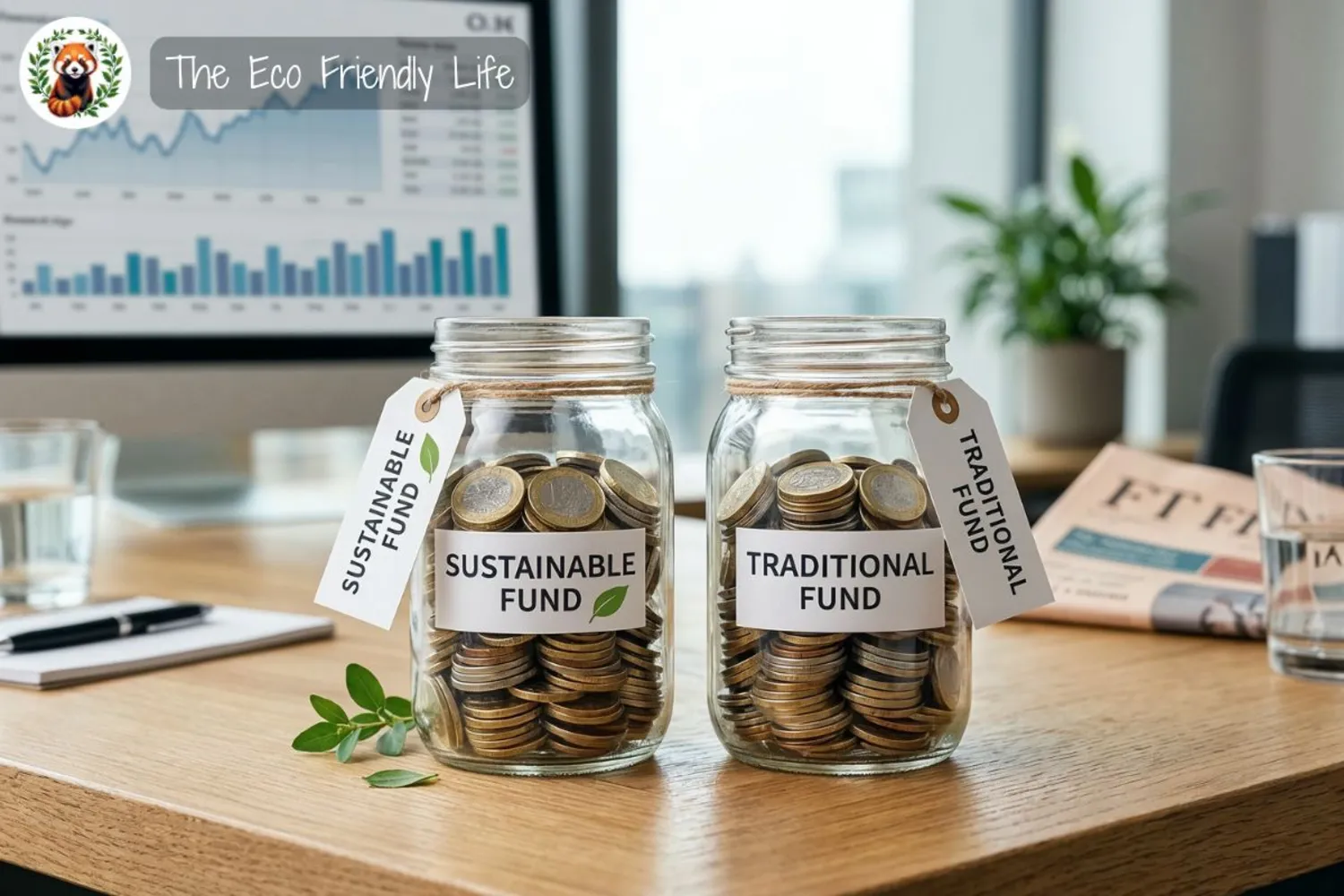
Returns matter, but they’re only half the story when it comes to choosing a fund. The other half — and the part that catches even experienced investors off guard — is knowing whether a “green” or “sustainable” label actually reflects what’s inside the fund. Greenwashing is real, it’s been penalized by regulators, and you can protect yourself with a few straightforward checks.
Greenwashing and How to Read a Fund Label
Regulators have already acted: Greenwashing in investment products isn’t a theoretical risk — the US SEC (opens in a new tab) fined WisdomTree $4 million in October 2024 for marketing three ETFs as excluding fossil fuels and tobacco while the funds actually held positions in exactly those companies. The enforcement confirmed that misleading ESG labels attract real regulatory consequences — and that they were widespread enough to prompt formal action. A healthy sign for the market, but it also means you can’t assume a fund’s name or marketing copy reflects its actual holdings.
Europe has set a quantified standard: The EU’s ESMA fund-naming guidelines came into force in November 2024, with existing funds required to comply by May 2025. The rule is specific: a fund using ESG or sustainability-related terms in its name must hold at least 80 percent of its assets in line with those characteristics, plus meet defined exclusion requirements. The ESMA guidelines (opens in a new tab) mark a shift from vague self-certification to a quantified standard. If you invest in European-listed funds, this offers a stronger protection baseline. Outside the EU, the bar remains lower — which is why checking underlying holdings stays essential wherever you invest.
How to read a fund yourself: The fund’s name is the least reliable guide to what it actually does. More informative are: its prospectus or Key Information Document (which sets out the exclusion criteria in plain terms); its top ten holdings (freely available on the fund provider’s website and on aggregators like Morningstar); and its expense ratio (a high-cost “sustainable” fund can easily underperform a low-cost conventional one after fees). A fund marketed as fossil-free that lists oil majors in its top ten holdings is a greenwashing red flag, full stop.
Free tools make this genuinely easy: You don’t need to dig through every prospectus manually. As You Sow’s Invest Your Values platform (linked in the Organizations section below) lets anyone enter a fund ticker and instantly see its fossil-fuel, weapons, tobacco, and prison exposure — free, no sign-up required. It’s one of the most practical tools a retail investor can use before trusting a label. Shareholder advocacy — the kind of community action (opens in a new tab) that organizations like As You Sow and Ceres lead — is part of what holds fund managers accountable.
Watch for greenhushing too: A subtler pattern is now emerging: greenhushing — fund managers deliberately downplaying or removing ESG branding to avoid political controversy in certain markets, even when their investment process hasn’t changed. This makes labels harder to read in the other direction: a fund that quietly dropped “sustainable” from its name may still apply the same ESG criteria it always did. The holdings and the prospectus remain more reliable than any marketing choice.
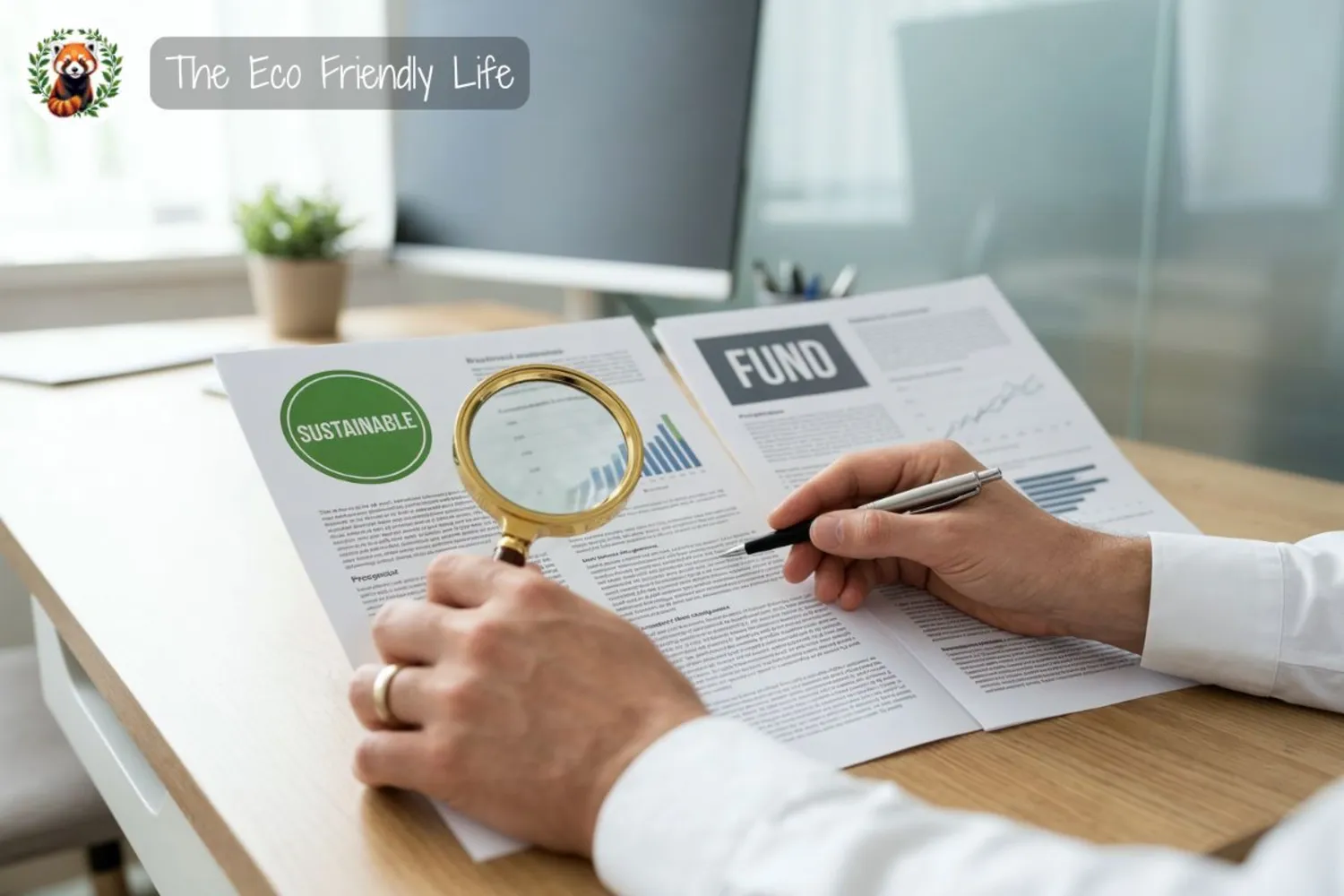
Once you can tell a genuine sustainable fund from a greenwashed one, the practical question becomes: where do you actually put this money? The good news is that most people already have the right accounts in place — they just need to look at what those accounts are invested in and whether a better option is available within them.
Brands and Tools That Support the Planet — Our Recommendations
Books to Go Deeper
Retirement-investment products can’t be honestly star-rated or personally endorsed the way a physical eco product can — they carry fees rather than prices, and the right fund for one reader may be entirely wrong for another. What I can recommend honestly is reading material: these three books will give you the knowledge to make your own informed choices. All are available through Bookshop.org, a B Corp that directs a portion of every sale to independent bookstores.
Your Essential Guide to Sustainable Investing — Swedroe & Adams
Where to Buy
Bookshop.org — a B Corp that supports independent bookstores globally. Their curated catalogue makes it easy to find well-reviewed titles on sustainable finance.
Our Recommendation
The most directly on-topic guide available — covers ESG, SRI, and impact investing, reviews the academic performance evidence, and ends with a practical portfolio how-to. Ebook $14.99 (available now); paperback $18.99 (may be on backorder — confirm at purchase). Chosen over shorter primers because it gives the why behind each approach, not just the label. It rewards careful reading rather than a quick skim. Ships globally: US via Bookshop.org, UK via uk.bookshop.org, elsewhere via Amazon.
ESG Investing For Dummies — Brendan Bradley
Where to Buy
Bookshop.org — same B Corp route, same independent-bookstore mission and globally friendly service.
Our Recommendation
The most beginner-friendly entry point if the Swedroe & Adams feels like too much to start with. Plain, structured chapters with no assumed background. Published 2021, so some specific examples date — but the conceptual framework still holds. Around $29.99 (confirm current price at Bookshop.org). Ships globally as above.
The Little Book of Common Sense Investing (10th ed.) — John C. Bogle
Where to Buy
Bookshop.org — hardcover ~$24.95 (confirm current price and ebook availability at Bookshop.org).
Our Recommendation
Not an ESG book — it doesn’t mention sustainability directly — but it’s the practical backbone that makes any sustainable retirement portfolio actually work: broad index funds, low costs, stay the course. The 10th anniversary edition adds chapters on asset allocation and retirement planning. Pair it with the Swedroe & Adams for the complete picture. Ships globally as above.
These three titles together cover the conceptual foundation, the toolkit to spot greenwashing, and the low-cost-index discipline that keeps a sustainable portfolio on track over decades. From here, we’ll move to the practical mechanics of actually building that portfolio — starting with the accounts you likely already have.
Building Your Portfolio: Accounts, Funds, and Fees
Start with what you already have: The account you contribute to right now is almost always the best place to begin — it’s tax-advantaged, and redirecting existing contributions costs nothing. In the US, that’s a 401(k), IRA, or Roth IRA. In the UK, a workplace pension, SIPP, or ISA. In Australia, superannuation. In Canada, an RRSP or TFSA. Many of these already offer a sustainable or ESG fund option within their menu — the first step is simply to log in and look. If yours doesn’t carry one, a single email to your HR team or plan administrator asking for an ESG option can genuinely move things: demand is what gets sustainable choices added to plan menus.
Fees compound against you more than most people realize: This part of sustainable retirement investing tends to get buried under the “green” conversation, but it’s critical. According to investor education (opens in a new tab) from the SEC, a 1 percent annual fee on a $100,000 portfolio growing at 4 percent a year costs roughly $30,000 more over 20 years than a 0.25 percent fee. That gap — the kind you’d see between a typical actively managed sustainable fund and a low-cost sustainable index ETF — can easily swallow the returns difference between a conventional and a green fund. The practical implication: prefer broad, low-cost sustainable index funds and ETFs over expensive niche alternatives. The low-cost discipline that underpins the Bogle title in our reading section applies to green investing exactly as much as to conventional.
Green fixed income belongs in the mix: Most retirement portfolios hold bonds alongside equities to reduce volatility, and the bond side can be values-aligned too. Green bonds (opens in a new tab) are issued specifically to finance environmental projects — renewable energy, clean transport, sustainable building — and are increasingly available through major bond funds and ETFs, not just direct issuance. Some sustainable bond index funds already hold a meaningful proportion of green-labeled bonds; it’s worth checking the fixed income composition alongside the equity screen.
Your cash is doing something too: A values-aligned financial picture extends beyond your investment portfolio. The bank where your emergency fund and everyday savings sit is also making lending decisions — and those decisions may not reflect your values at all. Moving that cash to a green bank (opens in a new tab) or a credit union with strong environmental commitments is a complementary step that doesn’t require touching your retirement accounts.
A final reminder — this is education, not advice: The right asset allocation for a sustainable retirement portfolio depends on your age, risk tolerance, time horizon, tax situation, and the country you live in. None of those are things a general guide can determine for you. A fee-only fiduciary advisor — one legally required to act in your interest rather than earn commissions — is genuinely worth a one-time flat-fee session. This article gives you the framework; a qualified advisor applies it to your actual life.

The mechanics are less exciting than the idea — log into your account, check the holdings, compare expense ratios, ask for a sustainable option, keep fees low. But those unglamorous steps, applied consistently across decades, are exactly what a functioning eco-friendly retirement portfolio looks like in practice. The ten tips below bring all of this down to actions you can take this week.
Practical Daily Tips You Can Action Today
You don’t need to overhaul your finances in one afternoon. These ten steps are sequential and manageable — most take under 30 minutes.
| Tip | How to implement | How it helps |
|---|---|---|
| Look up what your retirement account is actually invested in | Log into your pension, 401(k), or super account and open the holdings or investment options page. Screenshot it for reference. | You can’t align what you’ve never examined. Most people are surprised by what they find. |
| Check the expense ratio of every fund you hold | Find the factsheet for each holding — it lists the annual management charge or expense ratio. Compare like for like across options. | Lower fees compound into materially more money over 20–30 years. A 0.75 percent difference can cost tens of thousands. |
| Run your fund tickers through a free screener | Go to As You Sow’s Invest Your Values tool, enter your fund ticker, and read the fossil-fuel and weapons exposure report. | Reveals what’s actually inside the fund regardless of what the name says — no sign-up required. |
| Ask your employer for a sustainable option | Send one email to HR or the plan administrator noting that you’d like an ESG or sustainable fund added to the plan menu. | Demand is the main driver of sustainable options being added to workplace plans. One email can trigger a policy change. |
| Prefer broad index or ETF sustainable funds over single-theme funds | When comparing options, filter for diversified ESG index funds first. Check the number of holdings — broader is generally safer. | Diversification reduces single-sector risk; lower costs from passive index tracking preserve more of your return. |
| Read the fund’s exclusion criteria, not just its name | Open the prospectus or Key Information Document from the fund provider’s website. Look for the specific exclusion list. | The criteria are the substance; the name is marketing. This is the most reliable check for greenwashing. |
| Transition gradually rather than all at once | Redirect new contributions to your preferred sustainable option first. Move existing holdings in tranches if your tax situation allows. | Avoids mistiming the market and reduces the risk of triggering unexpected tax events from large one-off switches. |
| Use tax-advantaged accounts before taxable ones | Max out ISA, 401(k), SIPP, or super contributions before investing sustainably in a taxable brokerage account. | Tax efficiency compounds in your favour just as fees compound against you — it’s one of the highest-return moves available. |
| Green your cash too | Research values-aligned banks or credit unions in your country and consider moving your emergency fund and savings account. | Bank deposits fund lending; a green or ethical bank directs those deposits toward environmental and community projects, not fossil fuels. |
| Book a one-time session with a fee-only advisor | Search for a fee-only fiduciary in your country (US: NAPFA; UK: VouchedFor; Australia: FPA). Book a single planning session. | Fee-only means no commissions; fiduciary means they’re legally required to act in your interest. One session can catch costly mistakes. |
Small, deliberate steps compound over time — not just financially, but in terms of the influence your money exerts on the companies and sectors it flows toward. The FAQs below address the questions I hear most from people starting this journey.
FAQs
Is sustainable investing only for wealthy or expert investors?
No. Most workplace pensions and major brokerages now offer low-cost ESG index funds with no or very low minimum investment requirements. You can start with exactly what you’re already contributing — just redirected toward a more values-aligned option within the same account.
Will I sacrifice returns by going green?
The long-run evidence shows roughly competitive returns with no systematic penalty, though results vary year to year depending on sector and regional exposure. US sustainable funds lagged in 2024, largely due to clean-energy and growth-stock headwinds — not because of anything inherent to sustainability. There’s no guaranteed premium either way. Over a multi-decade retirement horizon, low costs and broad diversification matter far more than the green-versus-conventional label.
How do I know a fund isn’t greenwashing?
Look past the name to its actual holdings and exclusion criteria in the prospectus, and run it through a free screener like As You Sow’s Invest Your Values. US and EU regulators now penalize misleading fund names, but the holdings list remains the most reliable check you have, wherever in the world you invest.
Can I make my existing pension greener without switching providers?
Often yes. Many workplace plans and pension providers already offer at least one sustainable or ESG fund within their menu. Check your investment options page first, and if nothing fits, ask your employer or plan administrator — adding a sustainable option to the menu is a common and increasingly straightforward request.
Isn’t this financial advice?
No — this article is general educational information. The choices that are right for you depend on your age, country, tax situation, risk tolerance, and time horizon. Please consult a licensed financial advisor — ideally a fee-only fiduciary — before making any changes to your retirement savings.
Organizations to Support — Our Recommendations
These three organizations are doing some of the most meaningful work to make investing more transparent, more accountable, and more aligned with the long-term health of the planet.
- As You Sow has operated as a US 501(c)(3) shareholder advocacy organization for more than 30 years. Their free Invest Your Values tools — the same screeners referenced throughout this article — let anyone check a fund’s exposure to fossil fuels, weapons, tobacco, and private prisons in seconds. You can support their work (opens in a new tab) directly; donations fund both the free tools and their ongoing corporate engagement campaigns.
- ShareAction is a UK-registered charity campaigning to make responsible investment the norm rather than the exception. Their Pension Power initiative specifically helps individuals green their workplace pensions, and they explicitly refuse funding from for-profit investment firms to preserve their independence. Donate to ShareAction (opens in a new tab) to support that work.
- Ceres is a US non-profit that has spent more than 35 years mobilizing investors and companies on climate risk and sustainability, operating through the Ceres Investor Network and co-leading Climate Action 100+. Their influence on how major institutions vote their shares and engage with companies is significant and growing. Support Ceres (opens in a new tab) to back this work.
Each of these organizations does work that directly benefits retail investors — the free tools, the advocacy, and the policy engagement all make the sustainable investing landscape more transparent and more honest for everyone.
Resources and Further Reading
If you want to go deeper on any part of this topic, these two authoritative resources are the most useful starting points.
- CFA Institute — What is ESG Investing? A neutral, professionally produced primer on ESG concepts, the different approaches (integration, screening, impact), and how fund managers apply them in practice. Written for a general audience by the global body for investment professionals. Read it at cfainstitute.org (opens in a new tab).
- Global Impact Investing Network (GIIN) — the leading non-profit for impact investing globally. Their site provides definitions, market-size data, and research for readers who want to go beyond ESG integration into investments that aim for measurable, intentional environmental outcomes. Start at thegiin.org (opens in a new tab).
Between these two resources and the books in the section above, you’ll have more than enough to move from curious to genuinely informed before making any decisions about your retirement savings.
Our Related Articles

What Are Green Bonds And How Do They Work?
Most people are familiar with traditional investing — shares, property, pension funds — but far fewer have heard of an instrument that lets you earn…
Read More (opens in a new tab)
How To Choose A Green Bank: What To Look For
Money is often the forgotten frontier of sustainable living. While many of us diligently sort our recycling, switch to LED bulbs, and reduce our meat…
Read More (opens in a new tab)
An Introduction To Sustainable And Responsible Investing (SRI)
Sustainable and Responsible Investing represents a fundamental shift in how people worldwide think about the relationship between money and meaning. This approach integrates environmental stewardship,…
Read More (opens in a new tab)Conclusion
Building an eco-friendly retirement portfolio is less complicated than it sounds and more impactful than most people realize. The first step is understanding that sustainable investing is a spectrum — ESG integration, negative screening, thematic funds, and impact investing all mean different things, and knowing the difference helps you choose the right approach for your situation. The performance evidence, looked at honestly, shows that going green doesn’t require accepting worse returns over the long run — though it’s not a guaranteed premium either, and 2024 was a reminder that short-term sector tilts create real variation year to year.
Greenwashing is real, but it’s also checkable: a fund’s holdings and exclusion criteria tell you far more than its name, and free tools like As You Sow’s Invest Your Values make that check genuinely accessible to any retail investor. The practical path — start with the tax-advantaged accounts you already have, find a low-cost sustainable index option within them, keep fees low, and get personalized guidance from a fee-only fiduciary — is unglamorous but powerful when applied consistently over decades. Your retirement savings are probably the largest pool of money you’ll ever manage. Knowing what they’re invested in is one of the most meaningful eco actions you can take.
Have you ever checked what your pension or retirement account is actually invested in — and if so, did anything surprise you?
