
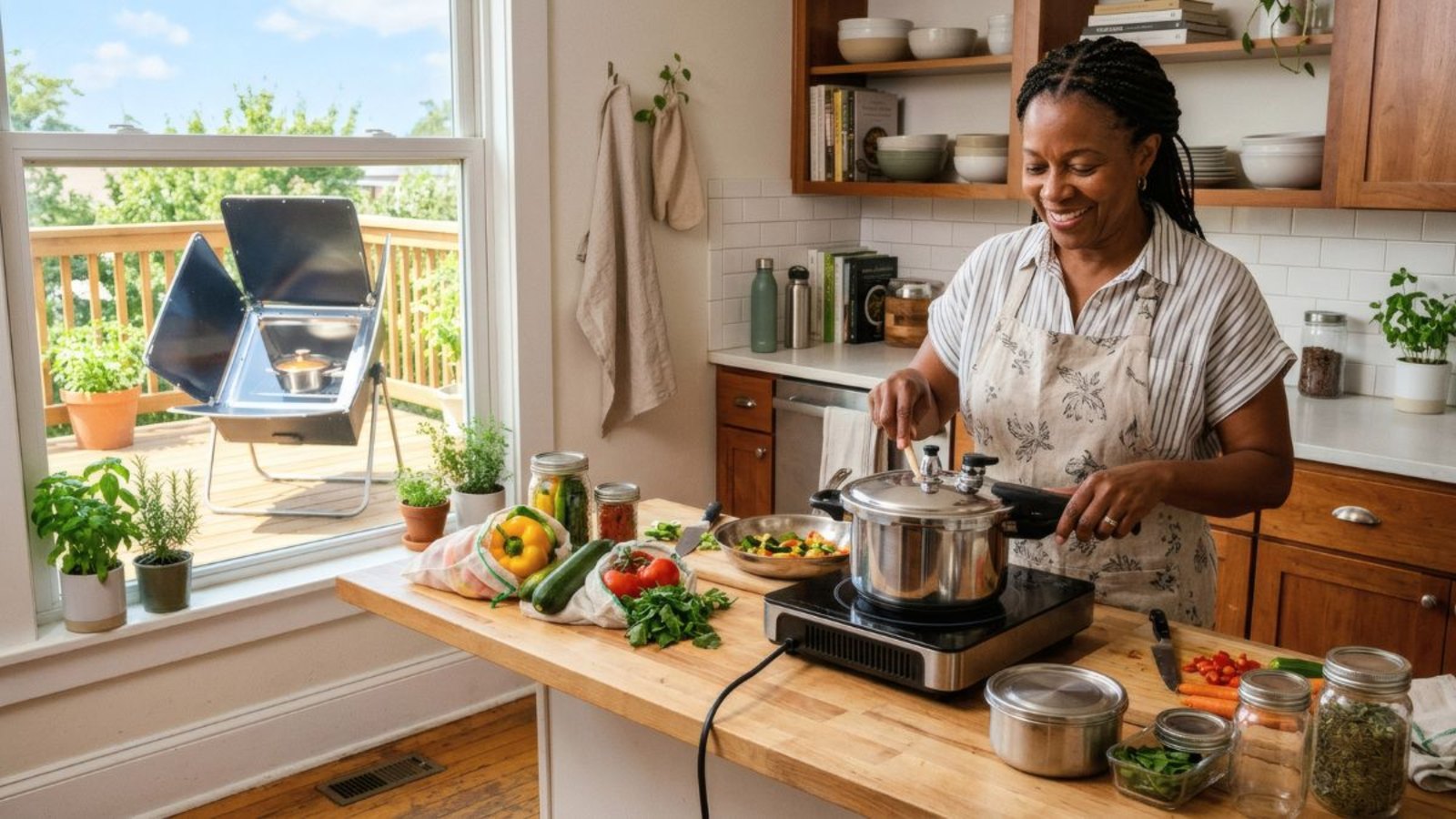

Cooking is one of the most energy-intensive things we do at home — yet it’s rarely the first place most of us look when we want to cut our household footprint. The truth is, the gap between the most and least efficient ways to heat food is enormous, and most households are losing a significant amount of energy (and money) every single time they turn on a burner or fire up the oven. The methods we grew up with are often far from the best options available today.
Hi, I’m Katrina! I’m a sustainable living enthusiast who genuinely loves cooking but has spent years figuring out how to do it without wasting resources our family doesn’t need to waste. I’m not a professional chef or an environmental scientist — I’m just someone who cares deeply about the planet and has learned a great deal by digging into the research, trying different appliances, and paying attention to what actually makes a difference at the dinner table. If you want to make your kitchen greener without it feeling like a chore, read on.
⭐ 🍳 🌿 Our Top Pick — Best Hybrid Solar Cooker
GoSun Sport-E Hybrid Solar Oven
I chose the GoSun Sport-E over other solar cookers because it solves the one limitation that puts most people off solar cooking — it works at night and on cloudy days too, plugging into any 12V power source so you’re never left waiting for the sun.
It harnesses direct sunlight to cook, bake, and boil without any fuel, and switches seamlessly to 12V electric power when sunlight is limited — making it the most versatile and practical zero-emissions cooker I've come across for everyday use at home or off-grid.
- ✅ Reaches up to 290°C (550°F) in direct sunlight
- ✅ Cooks for 2–3 people | Works at night via 12V | Ships globally
- ✅ Lightweight and foldable | Cool to touch during cooking
| Mid-range
👉 Shop GoSun Sport-E (opens in a new tab)The Energy Cost of Cooking — Why It Matters More Than You Think
Cooking is a bigger climate issue than most people realize: In developed economies, cooking accounts for 10 to 15 percent of total residential electricity consumption. Factor in refrigeration and water heating, and the kitchen can be responsible for more than a third of an average household’s energy bill. Globally, the stakes are far higher — the International Energy Agency (opens in a new tab) estimates that more than 2 billion people worldwide still lack access to clean cooking facilities, relying instead on solid biomass, kerosene, or coal to prepare their daily meals.
The health toll of inefficient cooking is measured in millions of lives: According to the WHO Household Air Pollution fact sheet (opens in a new tab), household air pollution from burning solid cooking fuels is linked to approximately 2.9 million premature deaths each year worldwide. In wealthier countries, the risk is more subtle but very real: cooking on a gas hob releases nitrogen dioxide and carbon monoxide directly into the indoor environment. Health research highlighted by the BayREN EASE Program (opens in a new tab) has pointed to induction cooking as a direct way to eliminate these combustion-related pollutants from the kitchen entirely.
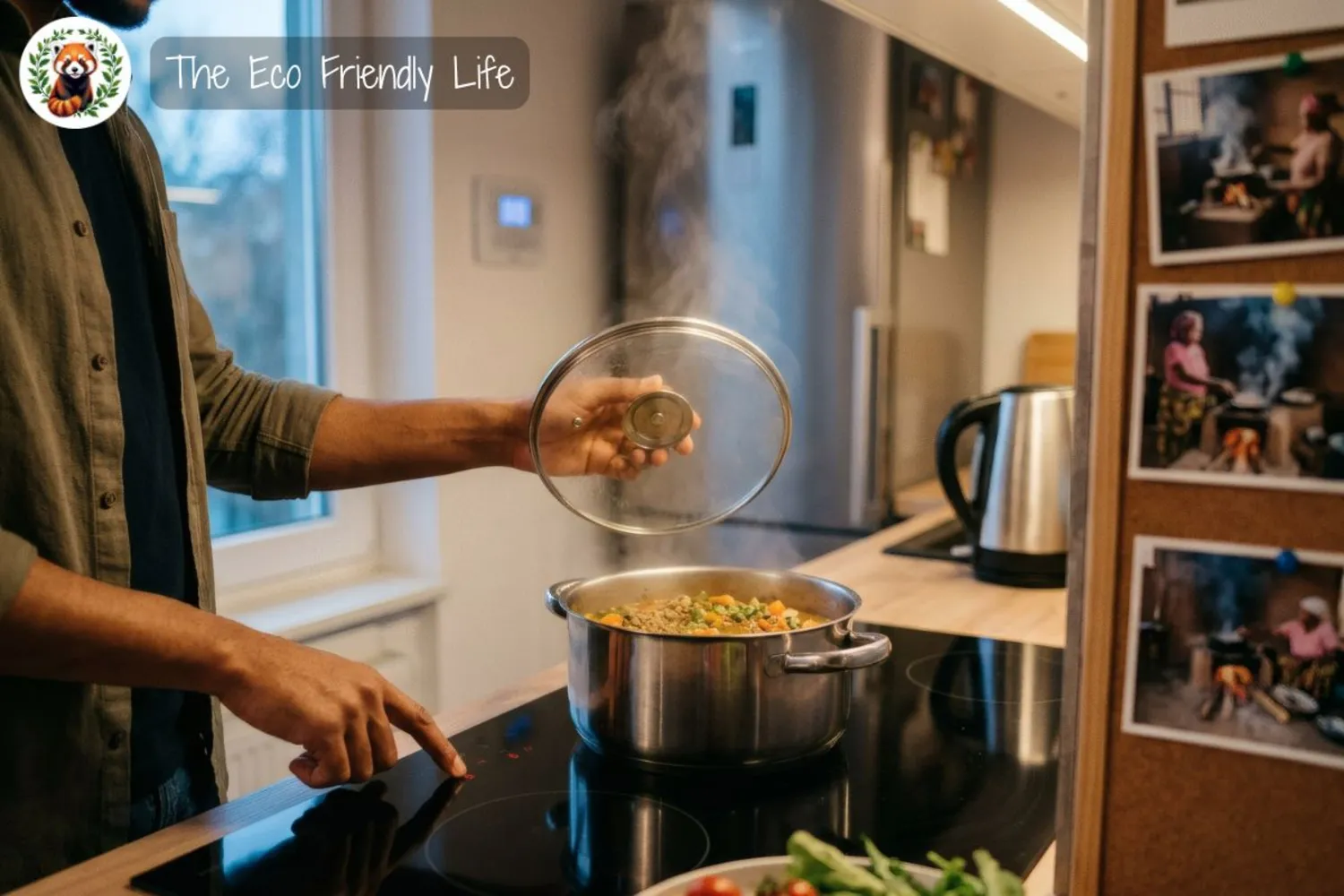
The global transition away from polluting fuels is moving too slowly: A peer-reviewed study published in Nature Communications (opens in a new tab) found that while the proportion of the global population relying on polluting cooking fuels dropped from 53 percent in 1990 to 36 percent by 2020, the absolute number of people using those fuels has barely shifted — hovering near 3 billion for three decades. Projections suggest approximately 2.7 billion people will still depend on polluting cooking fuels in 2030, with Sub-Saharan Africa accounting for more than 1 billion of them.
What happens in your kitchen is connected to this bigger picture: Every household that makes a more efficient cooking choice — switching from a gas hob to an induction plate, investing in a pressure cooker, or simply using a microwave to reheat rather than the oven — contributes to a global shift that matters. This connects directly to the broader decisions we make about plant-based choices (opens in a new tab) and sustainable eating, where the way we cook and what we cook work together to shape our overall food footprint.
The good news is that the most energy-efficient cooking technologies available today are also among the easiest and most practical to use. The first step is understanding exactly where the losses are happening — which is what the next section breaks down.
How Different Cooking Methods Compare
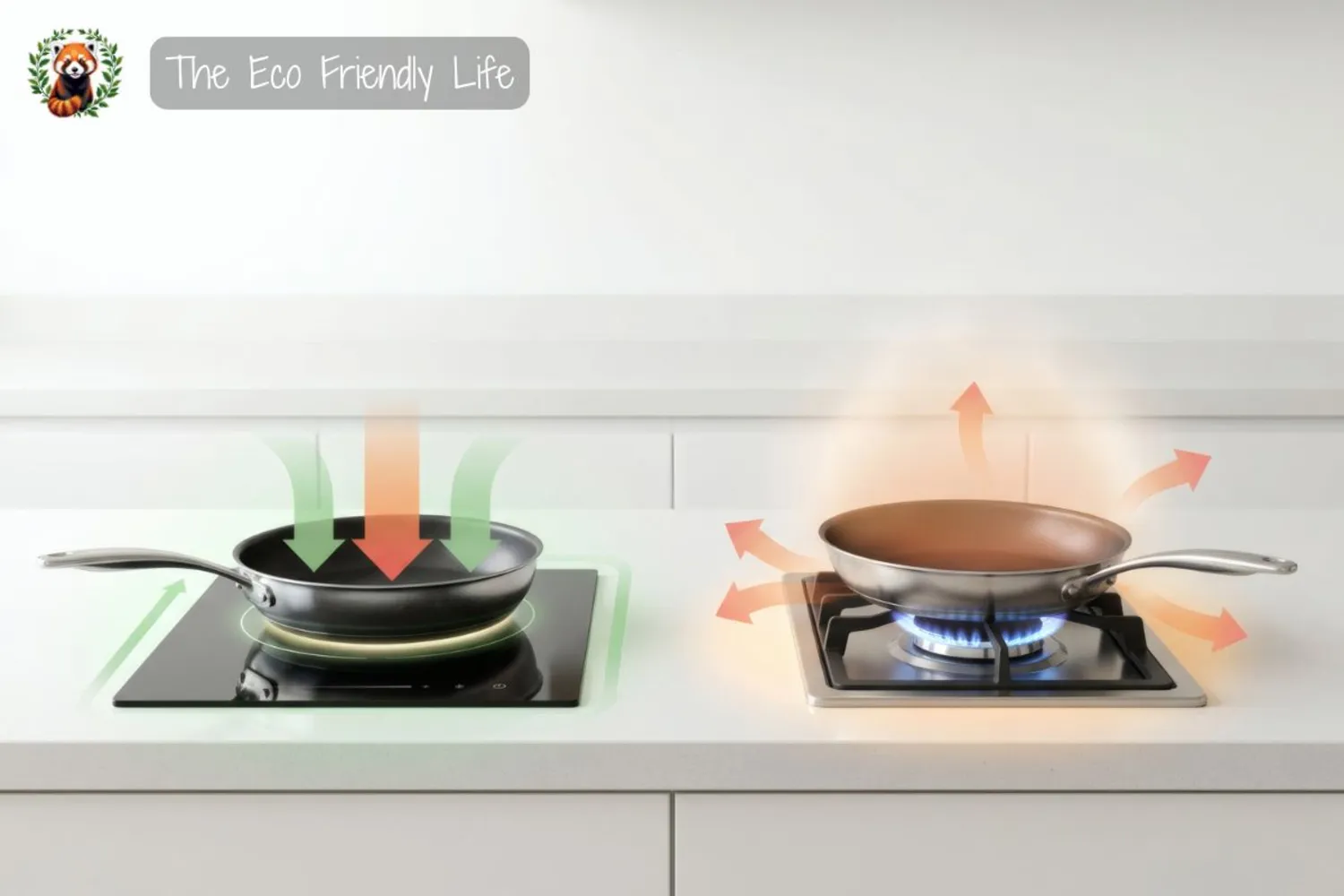
The gap between cooking methods is wider than most people expect: The energy efficiency of a cooking method is the percentage of input energy that actually reaches and heats the food. At the efficient end, modern induction cooktops achieve approximately 80 to 85 percent thermal efficiency — almost all the energy drawn from the wall goes directly into the cookware. Gas hobs sit at around 35 to 40 percent efficiency, meaning that more than half of the energy a gas burner consumes escapes into the kitchen air rather than into the food. Switching from gas to induction is not a marginal improvement: it roughly doubles stovetop cooking efficiency.
Induction leads, but several technologies offer genuine everyday value: NKBA’s 2025 report (opens in a new tab) on sustainable kitchen design noted that induction cooktops have become a centerpiece of that field, and for good reason — but they are not the only high-efficiency option. Electric resistance cooktops perform at 70 to 75 percent efficiency. Convection ovens, which circulate hot air with an internal fan, allow cooking at temperatures 25 to 50°F (15 to 30°C) lower than conventional models and reduce cooking times by approximately 25 percent. Air fryers, which use rapid convection in a compact chamber, consume 50 to 75 percent less energy than a preheated full-sized oven for portion-appropriate cooking tasks.
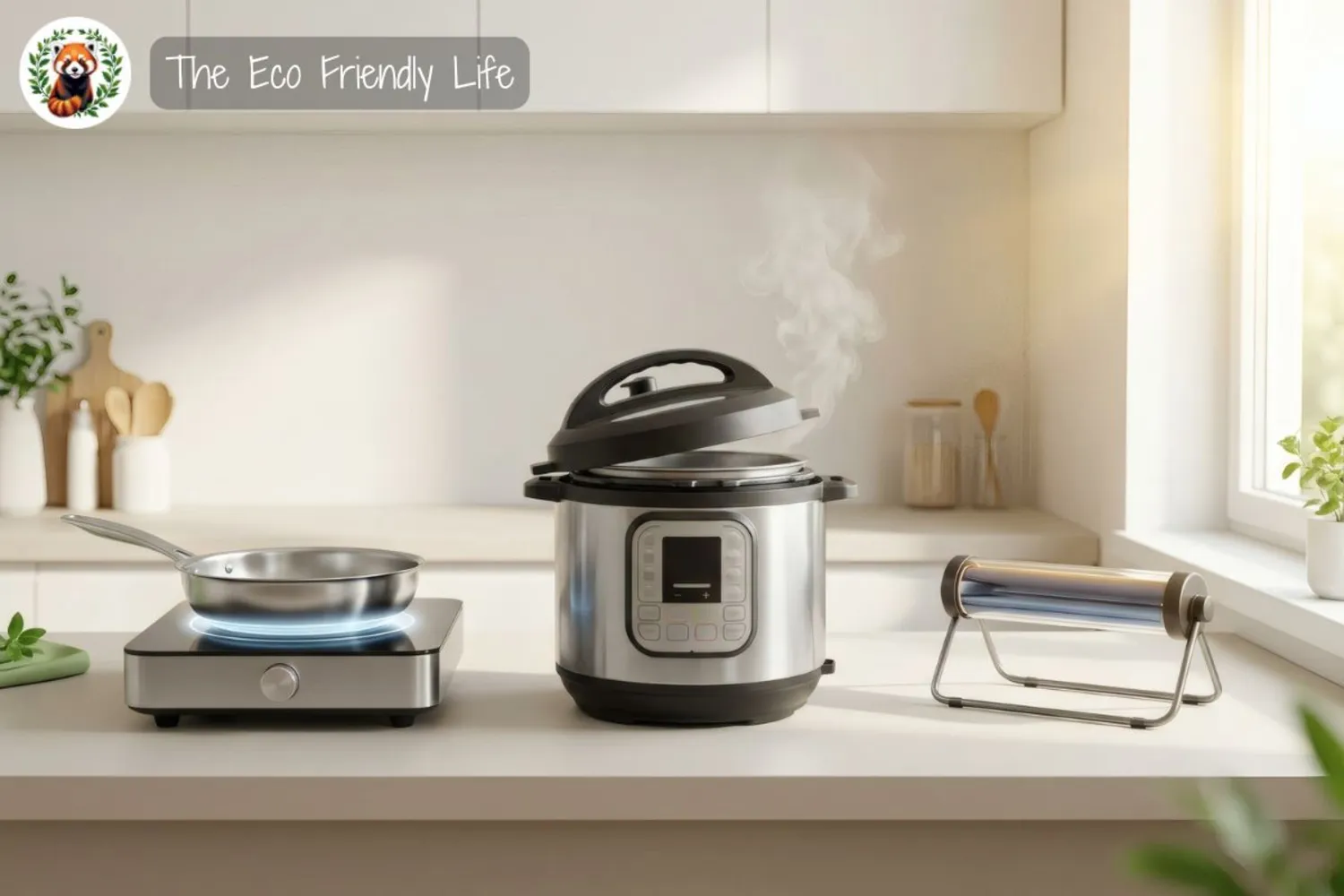
Pressure cooking offers some of the most dramatic energy savings of any single method: A peer-reviewed study in the Springer journal Energy Efficiency (opens in a new tab) found that optimized cooking techniques for staples like beans and potatoes can use less than half the energy of conventional stovetop methods. The sealed, high-pressure environment raises the boiling point of water, cutting cooking times for typical dishes by 50 to 70 percent. Slow cookers sit at the other end of the time spectrum — drawing just 150 to 300 watts over extended periods — but their total energy consumption per meal can be lower than a full-sized oven for long, slow-cooked dishes. Both methods also pair well with strategies to minimize food waste (opens in a new tab), since planning ahead for batch quantities naturally reduces the volume of food that goes unused.
Microwaves deserve more credit than they typically get: For reheating and small portions, a microwave uses 50 to 80 percent less energy than a conventional oven performing the same task, because it heats food directly rather than heating an entire oven cavity first. Matching the cooking method to the actual task at hand is one of the simplest and highest-impact habits to build in any kitchen — a practice that fits naturally into a broader home efficiency guide (opens in a new tab) covering energy use throughout the house.
Once you know which methods are most efficient, the practical question becomes which specific appliances are worth your attention. That’s where the next section comes in.
The Appliances Making a Real Difference
Induction technology has moved from specialty to standard: A decade ago, induction cooktops were primarily found in professional or high-end home kitchens. Today, portable induction burners start at under $50 in many markets, and full induction ranges are increasingly price-competitive with gas equivalents. Industry testing consistently rates induction cooktops at approximately 85 percent energy-transfer efficiency — roughly double that of a standard gas hob. For households that cannot replace their full range immediately, a single portable induction plate used for high-energy tasks like boiling water or searing is an affordable starting point toward a more sustainable home (opens in a new tab).
Multi-cookers have redefined what efficient weeknight cooking looks like: Electric pressure cookers and multi-cookers — most famously the Instant Pot — integrate pressure cooking, slow cooking, sautéing, steaming, and rice cooking into a single appliance that typically draws between 700 and 1,200 watts. Because they cook faster than stovetop or oven methods, the total energy consumed per meal is substantially lower. For a family cooking three times a day, the cumulative savings over a year are significant — and our roundup of energy-efficient appliances (opens in a new tab) covers the wider household picture if you want to take the same thinking into every room. These appliances also remove the temptation to leave the oven running longer than needed, because meals that once took an hour in the oven take under 20 minutes under pressure.
Solar cooking is a zero-fuel option that’s more practical than it sounds: Solar cookers harness direct sunlight to cook without burning any fuel or using any electricity. Box-type solar cookers can reach internal temperatures of 150 to 200°C — sufficient for baking, stewing, and pasteurizing — while parabolic models concentrate sunlight to achieve temperatures above 300°C for frying and grilling. Companies like GoSun now offer portable, consumer-grade solar cookers designed for backyards, camping, and emergency preparedness, making solar cooking accessible well beyond the rural off-grid settings it was once primarily associated with.
⚙️🍳🌿 Recommended: GoSun Sport-E
I reach for the GoSun Sport-E on sunny afternoons when I want to slow-cook dinner without turning on a single appliance — and on overcast evenings it simply plugs into a 12V power bank and carries on without missing a beat.
- ✅ Foldable and portable | Cooks for 2–3 people | Solar or 12V electric
- ✅ Works at night and under clouds | No fuel required
ENERGY STAR (opens in a new tab) certification is a practical shortcut for buyers: In the United States, ENERGY STAR certified convection ovens are rated 18 percent more efficient than standard models and may qualify for federal tax credits of up to $840 under the Inflation Reduction Act. Even outside the US, the ENERGY STAR label is a useful proxy for efficiency — equivalent standards exist under the EU Ecodesign Directive and similar frameworks in many markets. When purchasing any new cooking appliance, checking for ENERGY STAR or equivalent certification is the fastest way to filter for efficiency without needing to parse a technical specification sheet. For those looking to extend these principles into growing some of their own food, our guide to sustainable gardening (opens in a new tab) explores how a kitchen garden can further reduce the energy footprint of meals.
With a clearer picture of the best technologies and appliances, the next step is knowing which brands are actually delivering on these promises — and where to find them.
Brands and Tools That Support the Planet — Our Recommendations
When it comes to energy-efficient cooking, choosing the right tools matters as much as knowing the right methods. The retailers and brands below have been selected because their products directly support more efficient cooking — through solar technology, multi-cooker innovation, air-frying, or sustainably made kitchen accessories. I’ve done my best to include options that are globally accessible or clearly label their shipping reach.
Our Recommended Brands for Adults
GoSun
GoSun makes some of the most innovative solar cooking products available to everyday consumers. Their GoSun Sport-E hybrid solar oven (opens in a new tab) can reach cooking temperatures of up to 290°C (550°F) using direct sunlight — and when sunlight is limited, it plugs into any 12V DC source to keep cooking at night or on cloudy days. I specifically chose GoSun because the Sport-E removes the biggest barrier to solar cooking: reliability regardless of weather or time of day. Ships globally.
Instant Pot
Instant Pot has changed the way millions of households think about weeknight cooking. Their Instant Pot Duo 6QT (opens in a new tab) combines pressure cooking, slow cooking, sautéing, and more into one 1,000-watt appliance that cuts cooking times by up to 70 percent compared with conventional oven methods. I like that it effectively replaces several single-purpose appliances — less energy wasted on devices sitting idle in the cupboard. Ships within North America (USA and Canada).
COSORI
COSORI specializes in countertop appliances designed around efficiency. Their air fryer range (opens in a new tab) uses rapid air circulation in a compact chamber to deliver crispy results using up to 85 percent less oil and significantly less energy than a full-sized oven — and because the models heat up almost instantly, there is no preheating cost. I appreciate that COSORI appliances are built to genuinely perform, which means you’re not tempted to fall back on the conventional oven out of frustration. Ships within USA and select international markets.
EarthHero
EarthHero is a curated sustainable marketplace whose eco-friendly kitchen range (opens in a new tab) brings together sustainable cookware, reusable food storage, and responsible kitchen tools that complement an energy-efficient cooking setup beautifully. I chose EarthHero because they vet every product against meaningful environmental standards — so you’re not just saving energy, you’re also avoiding the toxic coatings and single-use plastics that tend to sneak into conventional kitchen product lines. Ships within USA.
Our Recommended Brands for Families
Ninja Kitchen
Ninja Kitchen makes a wide range of family-friendly multi-cookers that punch well above their price point. Their Ninja Foodi PossibleCooker (opens in a new tab) combines slow cooking, searing, braising, rice cooking, and more in one compact appliance, cooking meals up to 30 percent faster than a conventional oven. A multi-cooker with this kind of versatility actually gets used rather than sitting in the back of the cupboard, which is the real test of a good family appliance. Ships within USA and UK.
Hamilton Beach
Hamilton Beach has a long history of making reliable, straightforward kitchen appliances at accessible prices. Their Stay or Go Cooker (opens in a new tab) is a brilliant low-wattage solution for family-sized meals, drawing around 200 watts over a long cook and using a fraction of the energy a conventional oven would for the same dish. I love recommending Hamilton Beach to families who want a simple, no-fuss entry point into energy-efficient cooking without a large upfront cost. Ships within USA.
Choosing any one of these brands is a meaningful step toward a more energy-conscious kitchen, and most offer products across multiple price points — so there’s something here for every budget and household size. Pairing efficient appliances with quality induction-compatible cookware will get you the best results across every method covered in this article.
Building Energy-Efficient Cooking Into Daily Life
Small habits add up to meaningful savings over time: Most of the energy lost in a typical kitchen doesn’t come from a single bad appliance decision — it comes from dozens of small inefficiencies repeated across three meals a day. Building a green lifestyle (opens in a new tab) is as much about these everyday choices as it is about big-ticket purchases. Something as simple as using a lid on a pot traps heat and speeds up cooking, while matching the right pan size to the burner can prevent more than 40 percent of a burner’s heat from escaping around the sides, according to a CLOU Global analysis (opens in a new tab) of cooking energy efficiency. For a broader look at the numbers behind energy-efficient cooking habits, the Uswitch energy guide (opens in a new tab) is a practical starting point.
Matching the appliance to the task is the most underrated efficiency habit: Households routinely reach for the largest or most familiar appliance when a smaller, faster one would do the job with a fraction of the energy. Using the oven to reheat a single portion, for example, can use 10 to 15 times more energy than using a microwave for the same task. Developing a mental hierarchy of appliances — microwave first for reheating, air fryer or toaster oven for small portions, full oven only when its capacity is genuinely needed — is one of the most practical shifts any household can make.
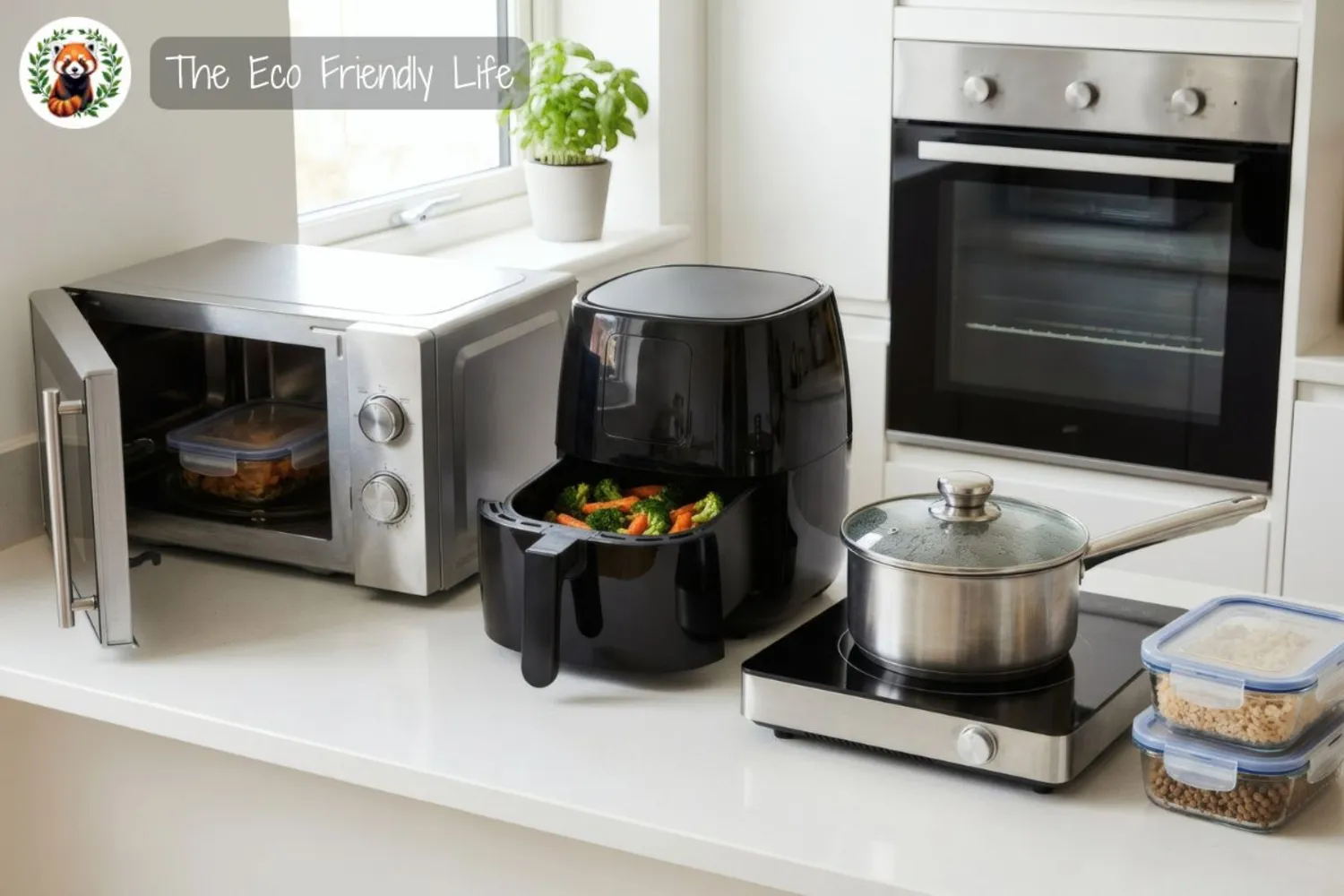
Batch cooking changes the energy math entirely: Cooking larger quantities of food in a single session and reheating by microwave throughout the week is dramatically more efficient than cooking fresh meals multiple times a day. Every time you turn on the oven, you’re spending energy preheating a large cavity — energy that’s wasted if you’re cooking only a small amount. Cooking a full batch of grains, roasted vegetables, or a slow-cooker stew on a Sunday, then reheating throughout the week, eliminates most of that repeated preheat cost. The food scraps from batch cooking sessions are also a great opportunity to start composting food scraps (opens in a new tab) rather than sending them to landfill.
Cookware quality affects efficiency more than most people think: Heavy-bottomed, flat-based pans with tight-fitting lids distribute heat more evenly, retain it longer, and reduce the power needed to maintain cooking temperatures throughout a meal. Poorly fitted lids, warped pan bases, and thin-gauge cookware all contribute to energy waste that adds up quietly over time. Investing once in quality induction-compatible cookware — stainless steel or enameled cast iron — pays dividends in efficiency with every single meal cooked.
For a quick-reference summary of the most impactful day-to-day actions, the table below pulls together ten of the best into one place.
Practical Daily Tips You Can Action Today
Here are ten straightforward actions you can start using today to make your cooking routine more energy-efficient.
| Tip | How to Implement | How It Helps |
|---|---|---|
| Use a lid while cooking | Cover pots and pans while simmering or boiling. | Traps steam and heat, reducing cooking time and energy use by up to 30 percent. |
| Match pan size to the burner | Use a pan that closely matches the heating element’s diameter. | Prevents heat from escaping around the edges; can improve gas-hob efficiency by 10 to 15 percent. |
| Pre-soak dried beans and grains | Soak overnight in cold water before cooking. | Reduces active cooking time — and energy use — by 25 to 50 percent for legumes and whole grains. |
| Use residual heat | Turn off the burner or oven 5 minutes before food is fully cooked. | Retained heat finishes the cooking process at zero additional energy cost. |
| Batch cook on weekends | Cook a large pot of grains, soup, or stew and portion for the week. | Eliminates repeated oven preheat costs; reheating by microwave is far more efficient. |
| Defrost overnight in the refrigerator | Move frozen items to the fridge the night before you need them. | Eliminates microwave defrost energy; helps the fridge run more efficiently too. |
| Use a microwave for reheating | Reach for the microwave first whenever reheating leftovers. | Uses 50 to 80 percent less energy than a conventional oven for the same task. |
| Descale and clean appliances regularly | Descale your kettle and clean oven seals and burner ports monthly. | Poorly sealed ovens lose up to 20 percent of their heat; limescale forces kettles to work harder. |
| Invest in quality cookware | Choose flat-based, heavy-bottomed pans with tight-fitting lids. | Better heat retention means less power needed to maintain cooking temperatures throughout a meal. |
| Use a portable induction burner | Use an induction plate for high-energy tasks if a full range upgrade isn’t yet feasible. | Roughly doubles stovetop cooking efficiency compared with gas, with no combustion pollutants indoors. |
FAQs
Here are the questions that come up most often when it comes to cooking more efficiently at home.
Is induction cooking actually better for the environment than gas? Yes, in most contexts. Induction cooktops operate at around 85 percent thermal efficiency, compared with 35 to 40 percent for gas hobs. Because they run on electricity, they can draw from renewable energy sources in ways that gas cannot. They also eliminate indoor combustion pollutants like nitrogen dioxide and carbon monoxide, directly improving the air quality inside the home.
Do I need to replace all my cookware to use induction? Only cookware that isn’t ferromagnetic needs replacing — in other words, cookware that a magnet won’t stick to. Most cast iron, stainless steel, and enameled cookware is already induction-compatible. Test your existing pans with a fridge magnet before buying anything new.
Is a solar cooker practical for everyday use? A solar cooker works well in direct sunlight and is genuinely practical for slow-cooking, baking, and boiling in climates with reliable sun. In cloudier climates, it works best as a supplement to other cooking methods rather than a primary appliance. Many users find it ideal for outdoor cooking, camping, or emergency preparedness.
Will an air fryer really save me energy compared with my oven? For small portions — typically 1 to 4 servings — yes. An air fryer reaches cooking temperature within minutes without preheating a large cavity, and its compact size means it maintains temperature more efficiently. For larger family-sized portions, the advantage shrinks somewhat and a full oven may be comparable.
Organizations to Support — Our Recommendations
A number of excellent global organizations are working to make clean, energy-efficient cooking a reality for billions of people — here are three worth supporting directly.
- Clean Cooking Alliance: A public-private partnership working to accelerate the global transition to clean cooking solutions, particularly in communities still relying on polluting solid fuels. The Alliance funds innovation in improved stoves, LPG, and electric cooking access in developing countries. You can donate to their work (opens in a new tab) directly through their website.
- Solar Cookers International: A nonprofit dedicated to promoting and expanding the use of solar cooking worldwide, with a particular focus on displaced populations and communities without reliable fuel access. Their work combines practical distribution of solar cookers with training and advocacy. You can donate to their mission (opens in a new tab) through their website.
- World Food Programme: The WFP’s clean energy for cooking initiatives help communities in crisis access safe, efficient cooking solutions as part of broader food security programs. You can support the WFP (opens in a new tab) to contribute to this work alongside their wider humanitarian operations.
Together, these organizations address energy-efficient cooking as both an environmental and a human rights issue — and all three accept direct individual donations.
Resources and Further Reading
If you’d like to go deeper on any of the topics covered in this article, these are the resources I’d recommend most.
- IEA Access to Clean Cooking Data Hub: The International Energy Agency’s SDG7 clean cooking hub (opens in a new tab) provides the most comprehensive and regularly updated global data on cooking fuel access, technology transitions, and policy progress — essential reading for understanding the full scale of the challenge.
- ENERGY STAR Certified Products Database: The US EPA’s ENERGY STAR program (opens in a new tab) allows consumers to search certified cooking appliances by category, helping you identify verified efficient models before purchasing. EU equivalent standards and related global certifications are also discussed.
- Nature Communications — Global Cooking Fuel Study: The peer-reviewed Stoner et al. study (opens in a new tab) in Nature Communications is one of the most thorough analyses of global cooking fuel trends from 1990 to 2030, and worth reading in full to understand the scale and trajectory of the transition still needed.
These three sources are excellent starting points for anyone who wants to understand the science, the data, and the solutions behind energy-efficient cooking more deeply.
Our Related Articles

Top Energy-Efficient Home Appliances For Every Room
Every appliance in your home is quietly drawing power, and over time those kilowatts add up to a significant chunk of your household energy bill…
Read More (opens in a new tab)
The Environmental Impact Of A Plant-Based Diet
Every meal you eat tells a story about our planet. The choices we make at the dinner table have an impact far beyond our homes,…
Read More (opens in a new tab)
How To Make Your Home Energy-Efficient
Rising energy costs and growing environmental concerns are driving more people than ever to rethink how they power their homes. The good news? Making your…
Read More (opens in a new tab)Conclusion
Cooking with energy efficiency in mind doesn’t require a complete kitchen overhaul — it starts with understanding where the waste happens and making deliberate choices to reduce it. From switching to induction for high-energy tasks, to using a pressure cooker to slash cooking times, to simply putting a lid on a pot, the actions available to every household are practical, affordable, and impactful.
The technologies driving more efficient cooking are better than they’ve ever been, the financial incentives to adopt them are growing in many markets, and the environmental case has never been clearer. Whether you start with a single portable induction burner, an air fryer, or a GoSun Sport for outdoor cooking, every change in the right direction counts.
What’s the biggest energy habit you’d like to change in your kitchen? Drop your thoughts in the comments below — I’d love to hear what has made the biggest difference for your family.
